Started the mapping project last weekend. Decided to do McAbee beach, as I like diving there.
Didn't go a smoothly as we had hoped, but actually I was satisfied overall. I think we made a reasonable start. Going to take a lot of trips to Monterey to get it finished though (IMHO).
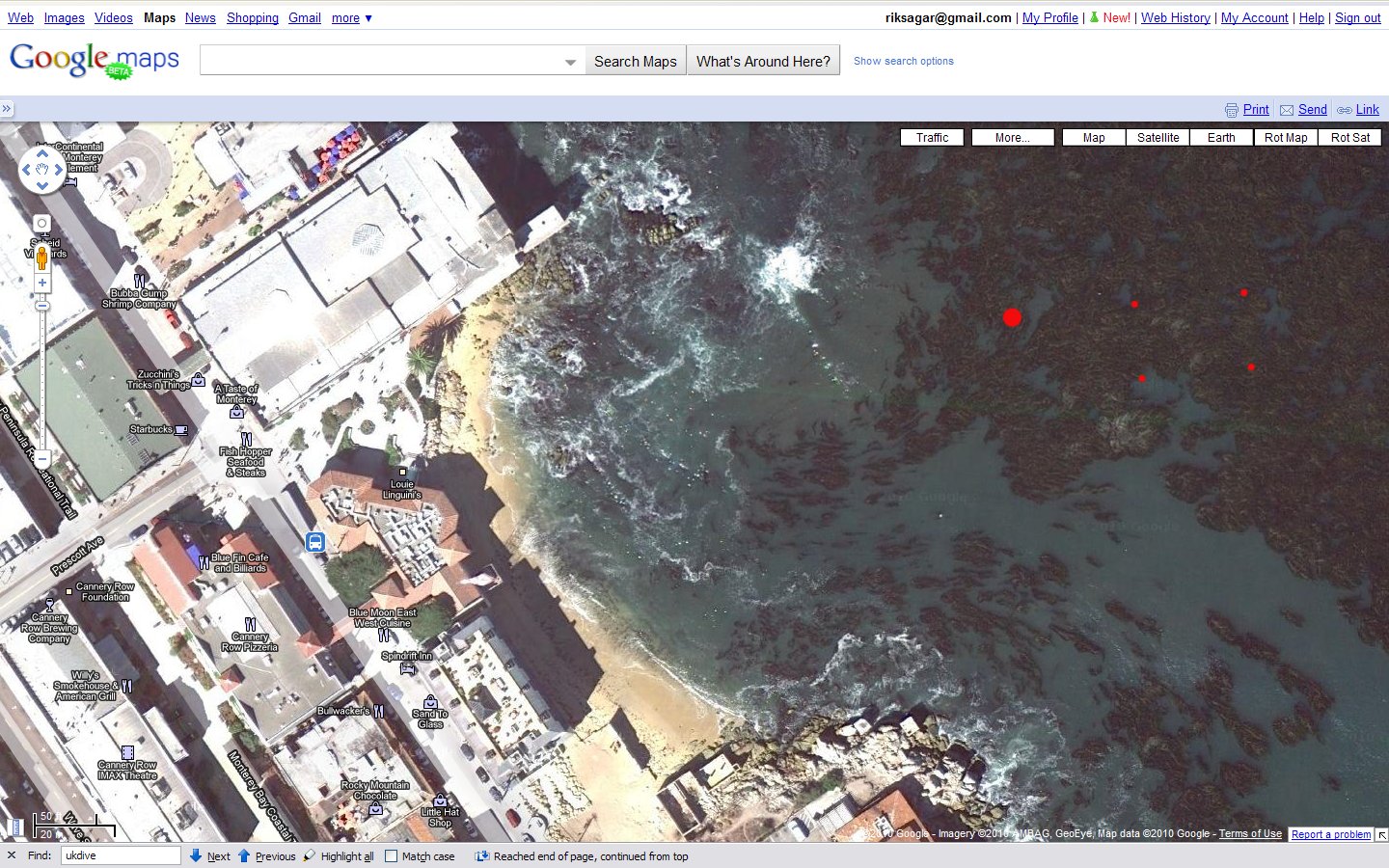
As far as I can tell (using compass navigation and fin kicks), we actually mapped the area under water indicated by the smaller red dots on the image below.
I didn't realize just how much dive gear you can get via amazon.com!
There's a lot of stuff I would still want to buy from my local dive shop, to try for fit and check-out how it works, etc. But things like reels, floats, flags, etc., I'm sure is OK to buy online and save a few bucks.
We learned that diving with "heavily modified" or "improvised" equipment could be dangerous. We should be cautious of people who use heavily modified equipment and we shouldn't encourage people to use it. But I think my adapted gloves are probably OK.
I tried these out in Monterey at the weekend (McAbee Beach, 50F/10C). Didn't feel any colder than normal - not after the first few minutes. It was great to have to dexterity to actually operate clips and camera buttons.
The one thing I might do different next time is limit the modification to thumb and first two fingers. I was very nervous whenever I touched the bottom, or any rocks, that I might get stung, envenomed, grazed, etc.
I was reading this article about someone attempting to stay underwater for 5 days, which got me wondering how you eat underwater!
I suppose you can survive on smoothies and other 'suckable' food-stuffs. You know, things that will go through a straw. But would it be possible to eat real food?
Then as I read further through the article, it sounds like the lake he's in isn't the type of fluid you'd want your food stuffs to come in contact with! Maybe sticking to a liquid lunch is the right way to go.
Then there is the issue of "waste disposal". Does he plan to wear a diaper for five days? Surely he would need to change it once a day to avoid nappy-rash, which presents a floater risk. I'm not sure he's sufficiently thought this thing through.
I applaud his efforts to promote environmental stewardship though. Good luck Allen!
I have to admit, I'm crap when it comes to boats! I get sick at the slightest bit of choppiness.
So it was a guity pleasure on that recent boat dive when I managed to not hurl during the dive. I didn't even feel slightly queasy! I was even able to pig out on the food provided on the boat!
What was really satisfying was seeing so many of the other divers having such a rough time and chumming the water ;)
At one point there were so many divers hanging lifelessly off the back of the boat, I felt like I was in a scene from some 'lost at sea' movie. I wondered how many weeks we'd been out there and who I would need to eat first.
All props to the Dramamine. One 'Less Drowsey Formula' tablet an hour before getting on the boat. I have to assume this is what saved me.
I really like SCUBA radio - lots of great dive site information - great interviews at resorts and dive operators - reasonably funny banter while they're in studio
However, I have noticed that every time they're at a dive resort they always describe it as the best diving they've ever done. Now, either [a] they've got really bad memories (due to the amount they drink when they're on the road, or narcosis!?) or [b] you have to take what they say with a pinch of salt!
I realize they can't really say "this is the best diving I've ever done, at least since we were in Domilica last week", it would be a little unkind to the resort owner they're talking to at that time, but they can't simply say every new location they go to is the best ever!
Visit http://scubaradio.com, or subscribe to the podcast through MediaFly, or your other favorite feed-reader. It's probably on iTunes too, but I don't use that Apple crap!
This time last year I didn't even know we had wreck dives in California, but now I know there are four wrecks within 15mins boat ride of the shore.
I believe "wreck dive" was the PADI specialty of the month this month, which explains why the shop was running a trip to SD to dive off the Yukon.
I didn't bother doing the specialty class, but I did go on the dive. Of course, this limited me to the outside of the wreck, but as I'm more into diving for the fish than anything else, that wasn't much of a limitation.
The Yukon is a great wreck to dive. 366ft long and still intact, you get to 'fly around the boat', although the affect is slightly wrong as the boat is on it's side, not upright.
For me the best thing to do was 'fly' over the top of the bridge, past the crows nesty thing and to the smoke stacks, which you can peer into (but can't see far).
The crows nest was great as it's covered in little white anemones, making it look like a snowy winter's day.
From the crows nest you really get to see the whole layout of the ship. Wish I'd done this profile for the first dive, not the third.
Next best area, probably, was my close inspection of the life boat booms, and their covering of strawberry anemones.
Anemones seem to be the main inhabitant, there are many Metridium, Sheephead and Sinorita fish. I also think I saw a leopard shark, though it may have been a big Lingcod! Thinking about it, it was stationary in the shadows of the hull, which doesn't sound very shark like. Either way, it was a really big fish. At the end of the fourth dive we saw a very big bizarre jelly, just ahead of the bow, in about 90ft of water.
Finally it was nice to swim up to the top and the radio mast and see the stars and stripes next to the jolly roger. Wish I'd got a picture of that.
Besides the Yukon, we also did a dive on a smaller boat called the 'Ruby E', and a dive on a sunken radio tower. Tower was a bit of a jumble. I'm told it's also a nice site for looking for lobsters and eels. The Ruby was a nice little boat and totally covered in various shades of Anenome.
Well, a few months earlier than I originally wanted to do it, but I've signed-up as a DMC, over at Diver Dans.
Supposedly I need to get finished within a year! Hope I haven't bitten off more than I can chew!
First on my to do list:
- complete knowledge reviews for chapters (1) and (2) of the DM manual
- DEMP training - technically not a DMC prerequisite, but Tom wants me to do it
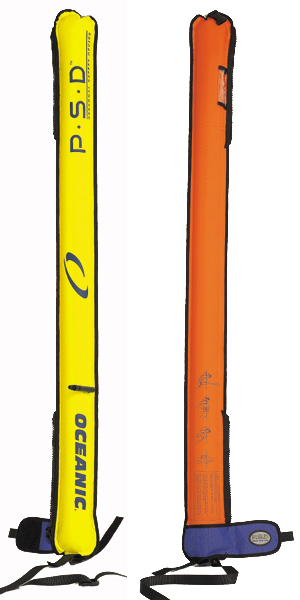
I was encouraged to buy a few month back, while doing my Rescue Diver training. You're supposed to have one incase you get stuck out in the water and you need to make yourself more visible for rescue services.
Sure you can get other emergency signaling tubes for about $10, where as this one costs about $40. But I was recently lucky enough to be snorkeling up at Lake Tahoe (not a dive trip at all) and I took my PSD with me. It worked great when my son and I were floating around in the water. We could use it to rest on, we hung our masks on it, I even used it as a lift bag at one point! I was snorkeling around and I saw a 5lb dive belt weight on the lake bed and I used my PSD to carry it back to shore, hence doing a bit of lake clean-up.
It's great that it rolls-up to the size of a coffee can, and it only takes two or three breaths to inflate, but it's buoyant enough to support 250plus pounds (based on our experience).
While a lot of your dive gear will costs you hundreds of dollars, this is something that costs just $40. It's a "safety" product, so it's not immediately sexy, but that fact that I could also use it to make a fun snorkeling trip safer and more stress free means it's one safety product that you can buy without thinking "This is something I don't want to buy, I'll never use it and I don't want to buy it, but I have to".
I lost 8 pounds at McAbee Beach. Not sure how it happened, at no point during the dive did I get over buoyant, so I have to assume it was during the ascent or on the surface swim to shore that the weight pouch got dumped.
Anyway, if you find a weight pocket for a chute II next time you're diving McAbee, Monterey, there's a $30 reward in it for you.
The research also attempted to identify a cumulative effect by having subjects consume several oxygen-heavy concoctions over the course of an evening. The result: fewer hangovers in the morning, as the body was better able to break down the alcohol and eliminate it from the system.
Did two dives at Point Lobos last Wednesday (Feb 10).
Conditions were good, the visibility was above 20feet. water temp was a little low (52F). waves were small and coming in from the West, so the cove was calm/sheltered. Surface conditions were OK. somewhat overcast, with patches of sun. Temp was probably in the low 60s.
I've only been to Lobos once before and to be honest, I didn't think it was a good dive that time. On that occasion I think we dove Cannery Point.
This time we dove in two spots. First dive was Cannery Point, second was Middle Reef.
Diving at Cannery Point means entering the water from the boat ramp, then turning left (as you face the water) to swim North, parallel to the parking lot.
We swam out as far as the first rock. at that point the surface waves were buffeting us quite a bit (foot or two). In this area you start to get out of the protected area of the cove.
We dropped down and swam out on about a 350degree barring. I had the intention of turning left, taking a 270degree, once we got to deeper water, but every time I tried to go West, we encountered rough surge against the rock wall. I repeatedly did North to West, to North, to west turns, but eventually conceeded that we were not going to get west around the cliff.
There wasn't as much wildlife on this dive as I expected. We saw a couple of large schools, and several Nudibranchs. I saw one larger rockfish, didn't see it long enough to get a picture, it disappeared behind some rocks.
The second dive, along Middle Reef, required a surface swim out to the middle of the cove. we swam away from the boat ramp on a North-East barring then once at the middle of the cove took a parallel tack to the parking lot wall. Before we got to the end of the cliff we dropped down. Vis on the surface was terrible! couldn't see the bottom, but we had started to encounter some light kelp, so I took that to mean we were over a rocky bottom.
Once we dropped down (it was about 20ft deep) the vis really opened up.
The bottom where we submerged was still pretty sandy, so I was worried that my assumption (i.e., kelp means rock) was bad. however, I then saw, out 15ft to the north, the start of the rocks (the 'reef'?!!).
We took the same approx barring as the last dive, 350degree (ish). It was a very easy out/back pattern.
This dive was great. there was so much to see. several very large rockfish (Vermillion?), crabs, shrimp, nudibranchs, a big Lingcod. Lots of swimming between rock pinnacles, so plenty to see on the rock walls. A lot less surge and swell on this dive, due to the more protected position in the cove.
The depth ranged down to 45ft, but due to the undulating nature of the reef most of the dive was below 30ft, meaning a good 50minute dive - even for an air hog like me!
Overall a successful dive trip. The second dive was one of my top five Northern Cal dives, possibly even my favorite.
It was great to get back in the water at the weekend for a couple of dives.
First trip out with my new Atom 2.0, so it was a simple dive down at Monterey's Breakwater. We considered McAbee, but there was quite a swell there and the waves were washing very high up the beach, and quite large I should add!
Took a swim out to the Metridium fields (bloosee link). Visibility was quite good out there - for Monterey at least - we had about 20ft vis'. Found the Metridium field quite quickly, they're in about 50 ft of water. Then we swam off on a 270degree barring and hit one of the old sardine pipes, which run from shore out to where the boats would unload (more info).
Second dive was along the wall of the breakwater. I know what you're thinking, diving at Breakwater when you've been diving 10+ years, sounds like a bit of a joke. But I have to say, there was a lot to see there. Great selection of crabs, decorator crabs, nudibraches, barnicles, rock fish, stars, the occasional seal and sealion. Another great thing - staying at 30 feet for the whole dive meant I didn't blow through my air in 35minutes, unlike the first dive.
Didn't take a camera, as I was focusing on the new computer, sorry no pictures to share. Next time eh!
The Atom is a fully integrated dive computer from Oceanic. It is a watch-style wrist mounted computer. Air is integrated via a wireless link to the transmitter 'dongle' that attaches to the first stage of your regulator.
I have to say, I'm loving the thing. I didn't realize how much easier diving would be with the computer mounted on the wrist.
Previously with gauges and computer on the hose on the left, I was juggling inflator, gauges, compass while diving. Now things are a lot more evenly distributed. Checking air and depth is just a quick flick of the wrist away, without needing to drop inflator or compass from the left hand.
Given the new found freedom of my left hand, I have taken the opportunity to move my compass to a retractor on the left. This also makes life easier - given my age! Checking direction can be done without focusing on a dial 9" from my face now (which I had to with the left wrist mounted compass). On recent dives, I hate to admit, focusing up close on my wrist compass was getting near impossible.
Had a fun trip to Tahoe a couple weekends back. Went and did an Altitude Dive Specialty with the Dive Club from Diver Dan's (http://www.dcosv.com/).
We had two days of diving. Saturday we did the certification, which entailed two dives from the DL Bliss state park. The first dive to about 50ft, the second slightly shallower at 40ft.
Visibility at the dive site was pretty good, 30 feet or so. Water temperature was great (compared to Monterey diving) at about 64F at the surface, staying warm all the way down to a thermocline at about 50ft.
There's not much to see in Tahoe, just a few Crayfish (crawdads as the locals call 'em) and one other type of fish that I haven't identified yet. The main thing to see is blueness and rocks.
The rock structure at the DL Bliss site is impressive. Because visibility is relatively good and these huge bolders 'perch' on a rock/sand gradient you have a view that is unlike any other I've seen on a dive. Great monoliths that emerge from the middle distance that you glide up to them.
Naturally the blueness of the lake, it's visibility and the lack of fish allows you to imagine you're flying between these mountains.
Saturday was a long day, two groups doing the certification (alternating) meant that we didn't complete the second dive and PADI paperwork until 5pm ish. We went back to the campsite for a shower, a couple of 'Arrogant Baster' Ale's then popped off to Tahoe City for dinner. Then I really was ready to crash.
Day two was an optional thing and not too many of us bothered to dive. Those who didn't certainly missed out.
We dove the second day at Sand Harbor. That's a bay on the other side of the lake (Nevada side) not far from the state line and Kings Beach. I think it's a state park.
Sand Harbor is a wonderful little beach area. It has a cafe, gift shop and visitor center with geology exhibit/diorama. Parking was $8 an d got very busy in the afternoon.
We started there around 9am (in the water a little after 10am). As with DL Bliss, it's straight in off the beach, weaving amongst the sunbathers.
The dive site here is much the same as DL Bliss. You can go out to a point between the two beaches and get into about 70ft of water, however we stayed a lot shallower today, not going much deeper than 30.
Be aware that there is a buoy line marking the beach area. If you dive outside of that area you need a float with you. Inside you don't. Apparently the Nevada coastguard is keen to enforce the rule. Provided you're in less than 30ft of water you're probably safely within the buoy area.
These dives were very relaxing. The lack of any kelp, the good visibility, the warm water mean there's practically no stress, just enjoy the dive. You can of course concentrate on some techniques, like improving your buoyancy or practicing your navigation skills.
On one dive we stayed inside the beach area (we had no dive float). We were told there was a submerged barge over by the buoys so we set out to find it. That took all of five minutes - it's quite a small area to search. The remainder of the dive was spend doing swim throughs of rocks, blowing bubbles at swimmers passing over head and generally 'getting wet'.
Had a great time on the channel islands trip. My boat dive fears were unfounded, the patch (Transderm SCOP - scopolomine) worked great and I had no trouble with sea sickness. There were some side effects after the trip though.
I was on the boat around 8pm Saturday and we hung out until bedtime. The crew were not onboard at the time. The boat left harbour around 4am I think - I woke up briefly - and headed for the North West end of Santa Cruz island (http://www.nps.gov/chis/planyourvisit/santa-cruz-island.htm).
Weather has been bad around the islands, with a large swell coming up from the south west, hence, we were destined to stay on the northwest end for the three days.
When I awoke, bleery, on Sunday morning around 8am the crew were still scoping out an appropriate dive site. That gave me time for a little 'pre-breakfast' before the orientation and the first dive.
We had a schedule of five dives per day on the first two days. As I hinted, the first dive of theday was before breakfast, but after a snack of bagel, toast, muffin, coffee, etc. The last dive of the day was a night dive around 9pm, after dinner but before dessert!
In the morning it was generally foggy, so the first dive of the day was usually a little dark. The third dive on both days was great in my opinion due to better light. I did the first three dives, skipped the fourth, to rest-up for the night dive. Night dives were good, the first night dive I didn't dive so well, but the second night dive I really enjoyed. The shrimp, crill and eel made it.
On the last day we moved from Santa Cruz towards Anacapa island, then back to Ventura. We had time for three dives on the last day. I slept in so I entirely missed the first, but I wasn't too bothered. The first dive was a wreck dive on "The Peacock". The dive was great, visibility was amazing and the fish variety was good. This is where I got my best spanish shawl photo. There was a bit of an issue at the end of the dive. I got my camera ina tangle with my inflater hose and fish ID chart, got in a bit of a panic, but recovered in time to ensure I made a SAFE accent ... With the exception of the full safety stop and a mere 350psi in my tank.
Second dive of the last day was the best of the trip. Around the kelp forest at Anacapa. We were bugged by Garibaldi and Sheephead, spotted lobster and glided through exquisit kelp.
The return to land from Anacapa was about 2 hours.
Once back on dry land that's when my troubles started. Removing the SCOP patch I soon started with lack of balance and blurred vision. These lasted from Wednesday until Sunday. I was exhausted, had trouble sleeping and weird dreams. 10 dives also took a toll on my ears. Got a ringing in my left ear for a week and ear ache started in both ears about Monday of the following week, which resulted in a doctor visit for antibiotics.